24 Oct 2026
Unraveling the Connections Between Community Rules and Content Curation Strategies

Community rules establish the boundaries that guide how content gets selected, organized, and presented in digital spaces, while content curation strategies translate those rules into practical decisions about what appears in feeds, forums, and archives. Researchers at institutions like the University of Toronto have documented these interactions through longitudinal studies of platform governance, showing that explicit guidelines on topics such as hate speech, misinformation, and commercial promotion directly influence the criteria curators apply when ranking or removing material. Data from multiple platforms indicate that communities with detailed rule sets experience measurable differences in content diversity and user retention compared with those operating under minimal frameworks.
Foundations of Community Rules in Digital Environments
Rules in online communities typically cover categories including behavioral standards, content prohibitions, and procedural requirements for participation, and these elements create the operating parameters for curation work. Observers note that platforms such as Reddit and Discord publish rule documents that moderators reference when deciding whether a post stays visible or gets archived, while Wikipedia maintains editorial policies that determine article inclusion and sourcing standards. Studies conducted by the Pew Research Center reveal that communities enforcing rules around verifiable sources and respectful discourse maintain higher rates of sustained contributions over time, whereas looser structures often see increased duplication or off-topic material.
October 2026 brought new reporting requirements under Canada's Online Harms Act that prompted several major platforms to revise their internal rule documentation, creating fresh alignment challenges for curation teams tasked with applying updated standards across millions of daily submissions. Those revisions emphasized transparency in decision-making logs, which in turn required curators to document the specific rule sections used to justify each removal or promotion action.
Mechanics of Content Curation Strategies
Content curation strategies encompass algorithmic ranking, human moderation queues, and hybrid systems that combine automated filters with manual review, and these approaches operationalize community rules into visible outputs. Research from the Australian eSafety Commissioner shows that platforms employing multi-layered curation, where initial algorithmic scoring precedes human verification, achieve greater consistency in applying rules related to illegal content and targeted harassment. Curators in such systems rely on rule-derived taxonomies to assign labels, prioritize review queues, and calibrate visibility thresholds for borderline material.
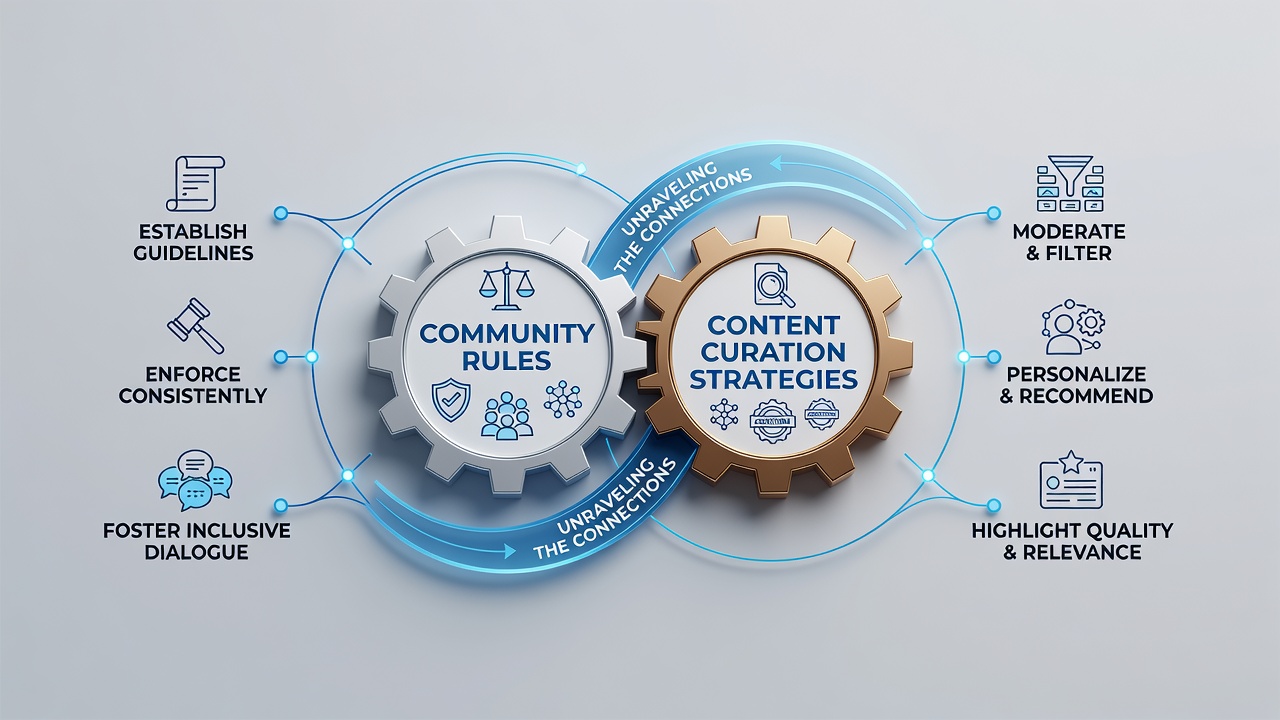
Effective strategies also incorporate feedback loops where rule violations trigger adjustments to curation parameters, such as tightening keyword filters or expanding review categories. Data released by the European Commission under the Digital Services Act demonstrate that platforms updating curation models in response to rule changes saw reductions in repeat violations within six months, particularly when curators received clearer guidance on context-dependent interpretations like satire versus targeted abuse. These adjustments frequently involve recalibrating recommendation engines to favor content that aligns with community-defined quality markers, including originality and source reliability.
Interplay Between Rules and Curation Outcomes
The connection between rules and curation becomes evident when examining how specific provisions shape selection criteria and visibility outcomes across different community types. In gaming communities governed by associations such as the Entertainment Software Association, rules against cheating and toxic behavior lead curators to prioritize streams and clips that demonstrate fair play, while deprioritizing material that features prohibited language or exploits. Academic analyses of these patterns indicate that communities maintaining detailed rule hierarchies produce curation outputs with lower rates of contested removals, because curators can cite precise sections when explaining decisions to users.
Rules addressing commercial content similarly direct curation away from promotional material unless it meets disclosure requirements, creating measurable shifts in the proportion of user-generated versus sponsored posts that appear in main feeds. Platforms that integrated rule-based scoring into their curation algorithms reported improved user satisfaction metrics according to internal platform reports shared with regulatory bodies in multiple jurisdictions.
Conclusion
Community rules and content curation strategies function as interdependent systems in which documented guidelines supply the decision frameworks that curators apply when managing information flows. Evidence from regulatory updates, platform reports, and academic research confirms that changes to one element reliably produce adjustments in the other, affecting everything from content diversity to compliance rates. As platforms continue adapting to evolving legal landscapes, the documented linkages between these two domains provide the basis for more consistent governance across digital communities.